
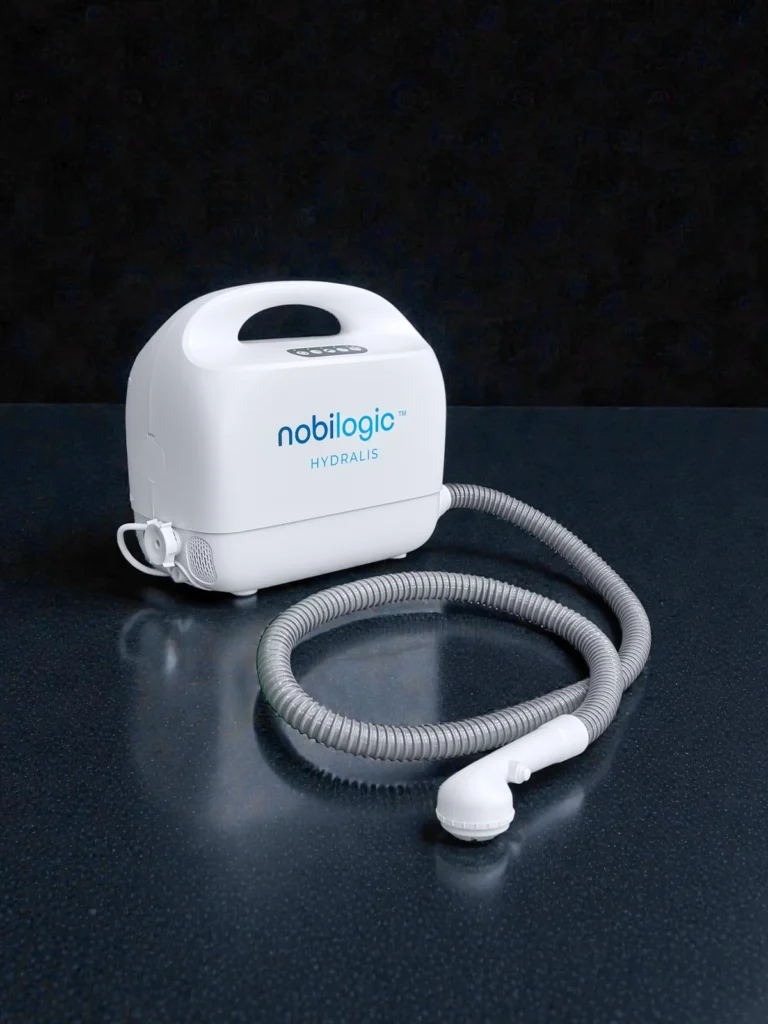

The Hydralis Story
Reading time: Approx. 8 mins. Published January 2026.
Allow us to introduce Hydralis. A device that fundamentally changes the way we perceive human care in environments where technology previously seemed to have reached its limits. Much like key innovations in other industries have reshaped our daily world, Hydralis arrives to end the era of compromises in personal hygiene and define a new standard of dignity for the 21st century.
Introduction: A Technological Imbalance
Modern medicine operates with extraordinary technical precision. Surgical robotics, real-time monitoring systems and advanced intensive care environments define contemporary healthcare standards. Yet one fundamental aspect of care has remained structurally unchanged for centuries: how we provide a proper shower to individuals who cannot stand or access bathroom facilities independently.
When mobility is lost, hygiene reverts to a basin and cloth. This method endured not because it replicated a shower, but because no technically structured alternative was available. It became a long-accepted compromise.
The Structural Problem of Basin-Based Hygiene
A shower is defined by three functional principles: continuous clean water flow, stable temperature and immediate removal of wastewater. Sponge-based bedside washing does not fulfil these parameters.
Mechanical wiping does not continuously remove contamination. Without uninterrupted rinsing and extraction, impurities are displaced rather than fully eliminated. In skin folds, residues and moisture may persist. Cleansing becomes redistribution.
Water prepared in a basin begins losing temperature immediately upon exposure. Within seconds, thermal stability declines. Maintaining warmth requires repeated replacement, interrupting the procedure and increasing handling.
Because wastewater is not actively extracted at the point of contact, bedding becomes damp. Moisture control depends on absorbent materials rather than engineered removal. The surrounding environment absorbs what should have been evacuated.
The caregiver carries a physical burden. Lifting, turning and repositioning the patient are inherent to the method. The process is sequential, fragmented and ergonomically demanding.
The patient carries the discomfort. Exposure is prolonged. The procedure resembles wiping more than bathing. Dignity becomes dependent on improvisation.
This approach was tolerated through repetition, not optimisation.
The Human Origin of the System
Hydralis did not originate from market analysis. It began in 2019, when the founder cared for his father after a serious fall left him bedridden.
Daily hygiene revealed the structural inadequacy of existing tools. Maintaining warmth was inconsistent. Managing water required physical effort. Preserving dignity required constant adjustment. The procedure never felt equivalent to a shower.
That experience defined clear technical requirements: stable temperature, controlled water delivery, immediate wastewater extraction and reduced physical strain during the process.
Development followed necessity.
The Bed Shower Principle
Hydralis was engineered to restore the defining parameters of a shower within a bed-bound environment.
The system delivers clean, temperature-controlled water directly to the skin while simultaneously extracting wastewater through a sealed vacuum circuit. Water application and removal occur synchronously. A controlled hydrodynamic film forms across the treatment surface. Fresh water contacts the skin continuously; used water is removed immediately.
The surrounding bedding remains dry because fluid is actively extracted rather than passively absorbed.
The integrated heating unit maintains consistent output temperature throughout the procedure. Thermal stability does not depend on repeated manual replenishment.
Specialised silicone attachments enable safe bedside hair washing, restoring a component of hygiene frequently reduced or omitted in immobile patients.
The procedure shifts from friction-based cleansing to controlled hydrodynamic showering.
From Compromise to System-Based Solution
For generations, bedside hygiene approximated a shower. It did not reproduce one.
Hydralis replaces approximation with structure. It introduces a closed-loop system designed to deliver continuous rinsing, stable warmth and immediate wastewater removal at the bedside.
Where basin-based washing represents a centuries-old compromise, Hydralis represents a technical reassessment of what hygiene for immobile patients should be.
